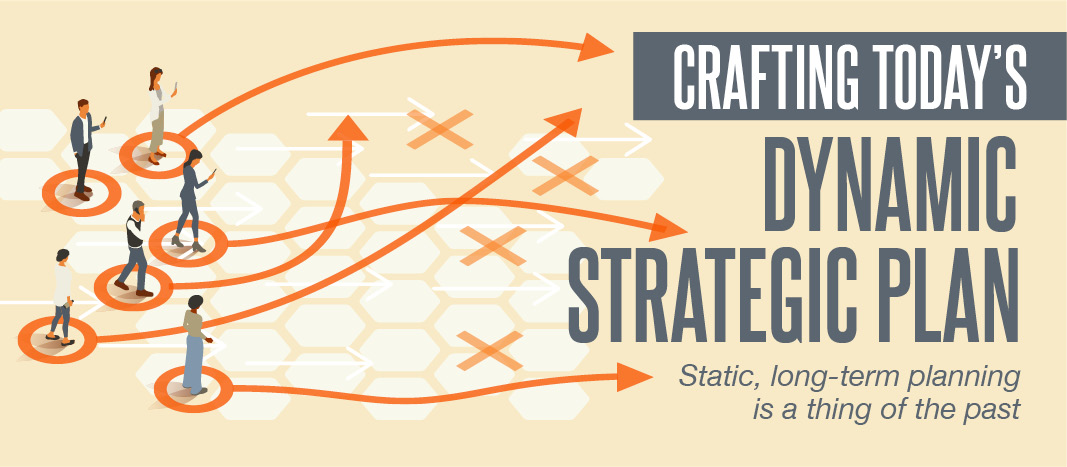
Static, long-term planning is a thing of the past
Ten-year, five-year, three-year strategic plans… They work remarkably well under stable conditions. But with today’s governmental policy changes, political and economic swings, fundraising pressures, and escalating community needs, these traditional “one and done” plans can leave nonprofits vulnerable.
That’s not to say long-term planning isn’t critical. It is. Strategic plans undoubtedly prevent harmful knee-jerk and reactionary responses. But today’s executives sitting on nonprofit boards must be nimble, continually assessing their organization’s strategic plans for effectiveness and validity in a volatile world. But how?
Adapting to change
Traditional strategic planning, which involves the sharing of insightful information about the organization and analysis of current practices, allows for customized planning in the nonprofit’s own language, versus a stock methodology. It can, however, be complemented by evermore-structured tools.
Organizations that adapt well to change implement both. They make a point of 1) staying true to their missions 2) incorporating daily briefings and scenario-planning into their routines, and 3) practicing a SWAT – Special Weapons and Tactics – mentality so that they can adjust strategic plans on the fly.
Ciara Claraty, a consultant with the Alford Group, agrees. “What’s required today is a planning approach that anticipates risks and really keeps the mission steady, even when environments are changing.” She suggests the following techniques:
The RACI framework
Change management planning recognizes that strategy works only if people embrace and follow it. Nonprofits must bring board and staff into planning early and equip them with tools and support for change; and they must align internal culture with external strategy, making adaptation part of the culture.
To do so, they can consult the RACI framework, which defines who is Responsible, Accountable, Consulted, and Informed. “Many times, strategic plans just assign who should complete the work, not who’s accountable – typically the CEO or executive director for whom ‘the buck stops here,’” says Claraty. The Consulted and Informed, she says, are often missed altogether, as in “Who should be in the room when we’re talking about a particular strategy – finances or legal, for instance? Who should be consulted and informed so the plan gets cascaded to the rest of the nonprofit and engages folks – so it doesn’t just live in the board room?” Often, community members, field staff, and external partners need to be part of the conversation.
Modular Planning: Strategy as Lego Blocks
What happens when one part of a nonprofit’s strategy goes up in flames mid-year? “You don’t throw away the whole plan,” says Claraty, who suggests a Lego block concept, where each block stands on its own. “You simply adjust or replace the block that no longer fits.” An example: a key leader responsible for a particular program leaves. Rather than scrap the program, the nonprofit pivots to a new leader or reconfigures the program.
Scenario Planning
Part of the Lego-block concept’s versatility is aided by scenario planning – preparing for A, B and C scenarios. A is the best case – increased funding, strong donor engagement, and favorable policy changes. B is baseline – stable conditions, no major disruptions. And C is the worst-case scenario; i.e. The nonprofit faces reduced donor support, economic downturn, new restrictions. “You pair those scenarios with modular planning so that you can quickly pivot,” says Claraty.
Surviving the age of chaos
Eowyn Bates, vice president of philanthropy and engagement for San Diego Natural History Museum, agrees that today’s strategic planning is synonymous with versatility. When the museum closed during COVID, her team leaned on their diversified funding model and pivoted to increased governmental support and biological consulting to sustain operations. More recently, they revised their mission and strategy to emphasize conservation, community engagement, and advocacy.
“Uncertainty,” she says, “can lead to analysis paralysis. We can’t wait for clarity – we’re in what futurist Jamais Cascio calls an Age of Chaos – and need to adapt our leadership model to handle a rapidly changing world.”
Caroline Dessert, CEO of San Diego LGBT Community Center, understands. She faces the prospect of losing nearly half of her nonprofit’s funding due to federal budget cuts. The community her nonprofit serves faces unprecedented negativity and hostility, a crisis in the LGBT community some believe is comparable to the AIDs crisis in the 80s and 90s.
But she’s not backing down. She’s planning for strategic growth over the next five to seven years – focused on financial management, additional programs and services, staffing, and messaging to rally the LGBT community about advocacy and fundraising. “We may serve the LGBT community, but by addressing homelessness, workforce development, and suicide prevention, we are part of the overall solution for San Diego,” she says. Her advice: “Fight! Fight! Fight!”
Balancing Long-Term Vision with Short-Term Pivots
The San Diego Natural History Museum has experienced its share of volatile challenges – Federal budget cuts affecting grants, increased competition for private dollars, and higher costs of living impacting employee retention and recruitment. Even so, the organization offers these tips to nonprofits focused on strategy amid short-term surprises:
- Realize that long-term vision is your anchor – the horizon your nonprofit is moving toward.
- Embrace a clear vision. It provides energy.
- Build trust among staff, volunteers, and constituents; it’s the only way to navigate pivots.
- Do the simple things right: clear communication, listening, transparency.
- Practice empathy and kindness. It is needed more than ever.
The Author: Richard Tollefson is founder and president of The Phoenix Philanthropy Group, an Arizona-based international consulting firm serving nonprofit organizations as well as institutional and individual philanthropists. www.phoenixphilanthropy.com
Factoid:
- Nonprofits in Times of Turmoil: *Build teams first, including internal and external individuals who are authentic, honest and aren’t afraid to speak up – even when it’s uncomfortable. *Focus on progress, not perfection. *Failures aren’t dead ends. They’re just points on the map to success.